KEY HIGHLIGHTS
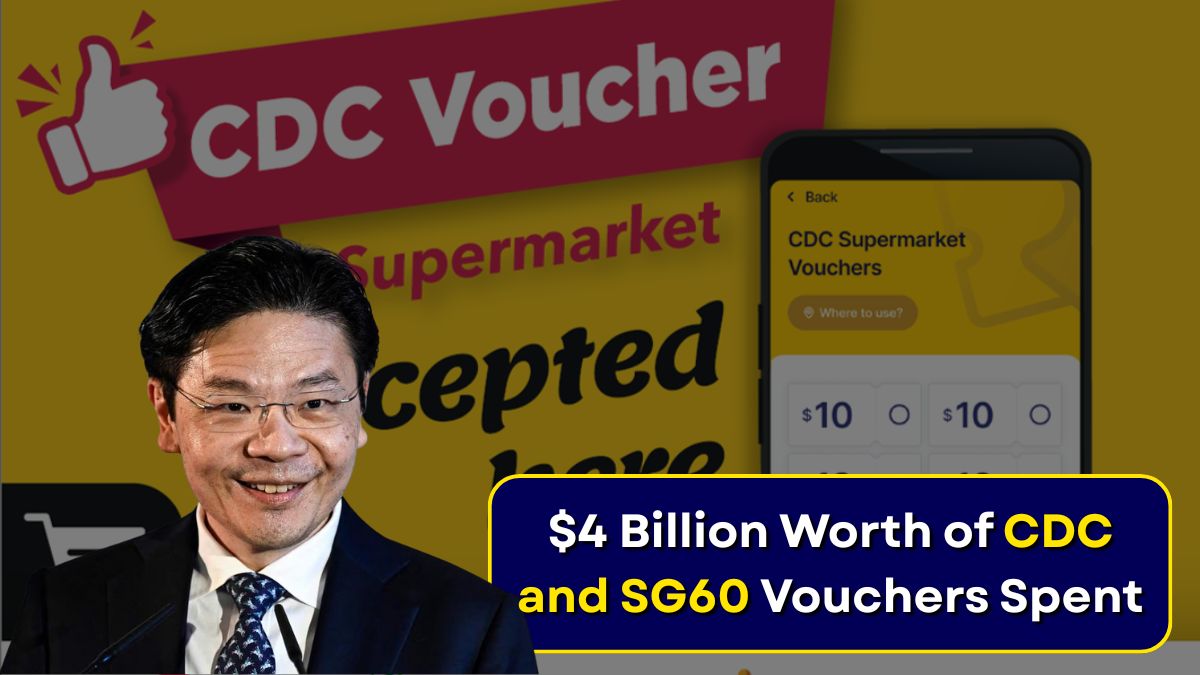
- Nearly S$4 billion in CDC and SG60 vouchers has flowed back into Singapore’s economy over four years
- 97.7% claim rate shows vouchers are actively used for daily essentials, not left untouched
- Each household can still claim S$300 in CDC vouchers, valid until 31 December 2026
Almost S$4 billion. That’s how much Singaporeans have spent using CDC and SG60 vouchers in just four years — and this isn’t abstract policy talk. This is kopi, groceries, hawker meals, tuition snacks, and daily necessities paid for in real neighbourhoods.
For many households feeling the pressure of higher food prices and utilities, these government vouchers have quietly become one of the most practical cost-of-living tools around. And for heartland shops and hawkers, they’ve provided steady, predictable spending during uncertain times.

Singapore’s cost-of-living support policies have taken centre stage in recent years, but few initiatives have matched the reach and scale of the CDC Voucher Scheme and SG60 Vouchers. These are not one-off handouts — they function as a targeted injection directly into everyday consumption, supporting both families and local businesses.
The Official Numbers: Where the Money Went
Here’s what the government data shows, clearly and plainly. Over the last four years, a total of S$3.995 billion worth of CDC and SG60 vouchers has been spent nationwide. Of this amount, S$2.127 billion went to heartland merchants and hawkers, while S$1.868 billion was spent at supermarkets.
This confirms one thing: the programme is not symbolic. It is a multi-billion-dollar domestic stimulus designed to circulate money where Singaporeans actually live and shop.
| Category | Amount Spent (S$) | Share of Total |
|---|---|---|
| Heartland shops & hawkers | 2.127 billion | Majority share |
| Supermarkets | 1.868 billion | Significant support |
| Total voucher spending | 3.995 billion | 4-year total |
| Claim rate | 97.7% | Exceptionally high |
| Current household entitlement | S$300 | Valid till 31 Dec 2026 |
Why CDC and SG60 Vouchers Matter for Singapore’s Economy
From an economic point of view, CDC and SG60 vouchers work as a targeted fiscal transfer. Instead of broad subsidies, the support goes straight into essential spending — food, groceries, and daily needs.
Official figures show that 89% of total voucher usage went towards food and essentials. This matters because it means the vouchers are doing exactly what they were designed to do: reducing everyday expenses rather than encouraging unnecessary spending.
For households, this translates into immediate relief. For small businesses, it means stable revenue. For the wider economy, it creates a multiplier effect as money circulates within local communities instead of leaking overseas.
A 97.7% Claim Rate Is Not Normal — Here’s Why It Happened
A 97.7% claim rate across seven tranches is unusually high for any government benefits programme. According to the Mayors’ Committee, this reflects three simple realities.
First, the vouchers are genuinely useful — everyone eats and buys groceries. Second, the claiming process is straightforward and digital-friendly. Third, Singaporeans trust that the vouchers work as promised.
Every eligible household can currently claim S$300 in CDC vouchers from 2 January, with validity extended until 31 December 2026. No rush, but also no reason to leave money unclaimed.
Heartland Businesses Are Clear Winners
One of the most visible outcomes is how the programme has strengthened neighbourhood businesses.
Back in 2021, around 10,000 hawkers and heartland merchants were part of the scheme. By 2026, that number has more than doubled to over 24,000 participating outlets. On top of that, eight major supermarket chains with 400+ outlets are now included.
This steady expansion shows how consistent government-backed spending can keep neighbourhood economies active, even when global conditions remain uncertain.
A Look at the Last 12 Months Alone
Zoom in on the most recent 12 months, and the scale becomes even clearer. Total voucher spending exceeded S$2.398 billion in just one year.
Of this, S$1.22 billion went to hawkers and heartland merchants, while S$1.178 billion was spent at supermarkets. Again, 89% of this spending went towards essentials, confirming that households are using vouchers for practical needs, not splurges.
This “sustained injection” of spending has helped shops plan better, retain staff, and continue serving regular customers.
The Quiet Digital Shift Many Don’t Talk About
There’s another benefit that doesn’t show up directly in dollar figures. CDC and SG60 vouchers have nudged digital adoption forward in a very practical way.
Many seniors learned how to scan QR codes for the first time. Hawkers who once relied on cash adopted digital payments. Residents became more comfortable using e-government platforms. All of this supports Singapore’s wider push towards cashless payments and digital inclusion — without forcing change overnight.
2025 Voucher Usage: What the Data Shows
The breakdown for 2025 offers useful insight into spending behaviour.
For the January 2025 S$300 CDC vouchers, 1.343 million households claimed them — a 98.8% take-up rate. Total spending reached S$396 million, split almost evenly between hawkers and supermarkets.
For the May 2025 S$500 CDC vouchers, 1.334 million households claimed them, with S$652 million spent in total. Again, spending was balanced across heartland merchants and supermarkets.
SG60 Vouchers: Targeted Support Across Age Groups
SG60 vouchers were introduced as part of broader SG60 initiatives, with different tiers of support.
Seniors aged 60 and above received S$800 each. 1.04 million seniors claimed their vouchers, with S$610 million spent.
Adults aged 21 to 59 received S$600 each. 1.83 million people claimed them, spending a total of S$740 million.
All SG60 vouchers expire on 31 December 2026, so timely usage matters.
Latest CDC Voucher Tranche: What Households Get Now
At the most recent January launch, 1.36 million households were confirmed eligible for the latest CDC tranche. Each household receives S$300, split evenly — S$150 for hawkers and heartland merchants, and S$150 for supermarkets.
This structure ensures both small neighbourhood shops and large retailers benefit, keeping spending balanced across the ecosystem.
Why Businesses Should Pay Attention (High-CPC Insight)
For businesses in finance, insurance, retail, fintech, and digital payments, CDC and SG60 vouchers are more than social policy. They drive higher transaction volumes, accelerate digital payment adoption, and strengthen customer loyalty in heartland areas.
These schemes indirectly support SME financing, payment infrastructure, retail leasing, and consumer analytics — making them relevant far beyond food and groceries.
Frequently Asked Questions
How much CDC vouchers can each household claim in 2026?
Each eligible Singapore household can claim S$300, and the vouchers are valid until 31 December 2026.
Where can CDC vouchers be used?
They can be used at participating hawkers, heartland merchants, and major supermarket chains across Singapore.
Are CDC and SG60 vouchers taxable?
No. CDC and SG60 vouchers are not taxable income.
What This All Means for Singapore
The numbers speak for themselves. Nearly S$4 billion worth of CDC and SG60 vouchers spent in the last four years has delivered real cost-of-living relief, supported neighbourhood businesses, and nudged Singapore closer to a more inclusive digital economy.
With S$300 CDC vouchers still available and valid until 2026, there’s no need to overthink it. Use them, support local shops, and make the most of a policy that’s already proven its worth.
Sources (Official Government Websites Only)
